


If you want to establish a constant flow of potential clients, it is essential to create a quality marketing funnel. Through a design that takes users through various stages, from the moment they learn about your product or service, until they finally make a purchase, a well-structured funnel has the potential to increase conversions. As well as generating income and cultivating a loyal customer base.
What is a marketing funnel?
A key concept in the world of marketing is “marketing funnel“, also known as the “purchase funnel" either "sales funnel“. We can define it as a map that shows you the journey that a potential customer takes from discovering a product or service until they finally make the purchase, and beyond that point. Imagine the funnel as a visual representation of the steps you take, as potential client, to transform you into a Satisfied Customer who makes recurring purchases.
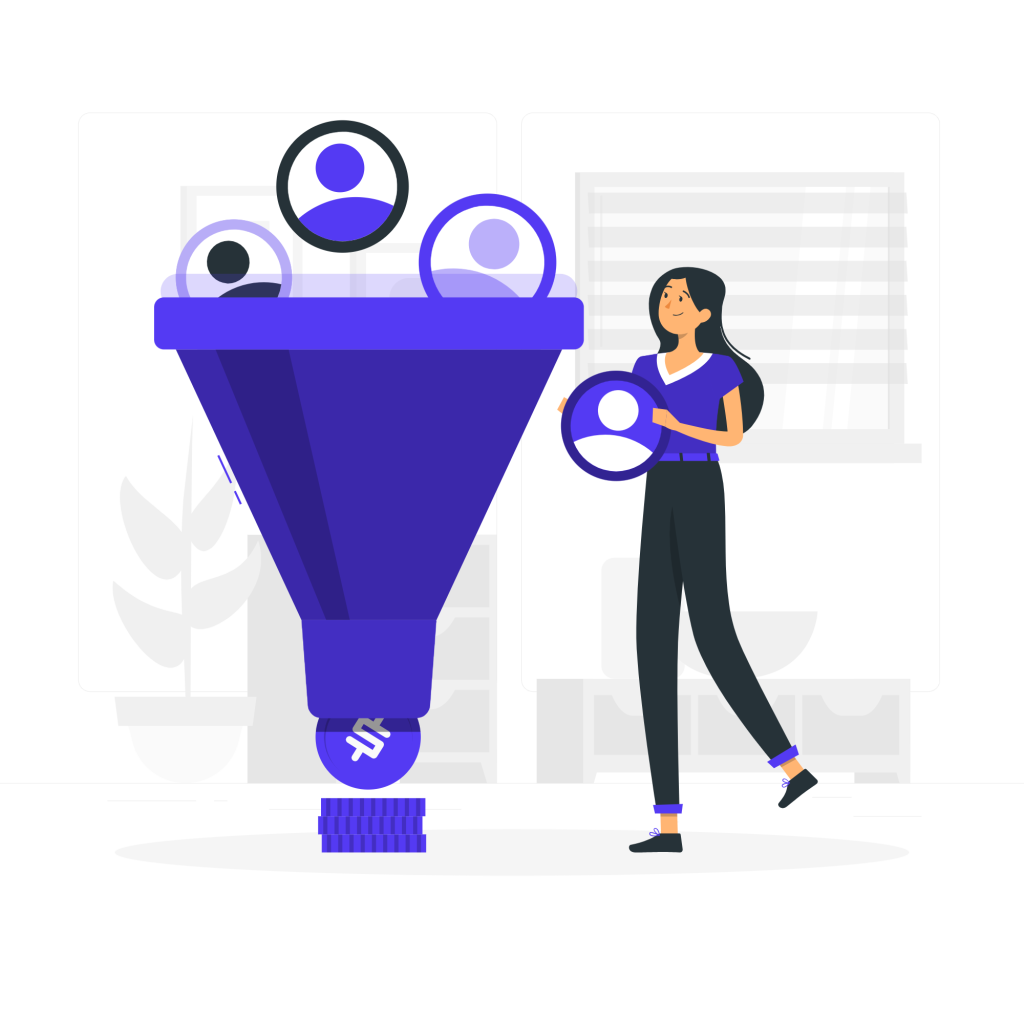
It's divided in different stages. These indicate where the user is in their relationship with the brand and how willing they are to buy. Such stages are designed to guide you through the purchasing process. At the same time, help the marketing expert or sales team to identify potential opportunities to convert you from a simple prospect into a customer who makes purchases.
Although it may seem simple, conversion funnels can become quite complicated due to a variety of reasons. These include:
- The variety of marketing channels available to choose from, such as paid ads and SEO.
- The diversity of needs among your potential clients.
- He variable level of knowledge What each customer has about your brand. Some may have heard of your company and are investigating alternatives. While others don't even know that there are solutions on the market.
Marketing Funnel Example
Someone may walk through the purchasing process through different phases, which could include:
- Read a blog article related to the product or service.
- Subscribe to an email list to learn more.
- Finally, make a purchase.
Or perhaps, your purchasing process is as follows:
- Listen to an ad on a podcast that promotes your product or service.
- Then, read a blog article that goes into more detail.
- Conclude with a purchase.
It could even be the case that someone takes the following route:
- See a social media post promoted by an influencer who endorses your product or service.
- Follow the link to a specific landing page.
- Complete the purchase on that page.
The reality is, if your product or service is sold online, there is likely a marketing process that potential customers follow. Whether you are aware of it or not.
Why is it important to determine a buyer persona?
A buyer persona is a detailed representation of your ideal client. This is a description that covers from demographics to interests, and from work experience to family size, all presented in a way that makes you look like a real person. Having a buyer persona offers a series of significant advantages for your marketing funnel, such as:
- Identify your ideal client. It allows you to define your target audience, understand their needs, goals, interests and weaknesses. By creating a profile, you can personalize your messages and strategies so that they connect effectively with them.
- Create more effective marketing messages. With a deeper understanding of your target audience, you can develop messages that focus on what they want. This leads to more efficient communication and increases the likelihood of converting prospects into loyal customers.
- Personalize the customer experience. You can personalize the customer experience at each stage of the funnel. This includes creating targeted, highly effective landing pages, emails, and offers that fit your needs and interests.
- Improve customer engagement. When you better understand your ideal customer, you can generate more relevant content that resonates with them. This can result in higher engagement and increase the chances of lead conversion.
- Optimize your marketing efforts. By focusing your marketing strategies on your target audience, you can save time and resources, avoiding strategies that have less chance of success.
Stages of a marketing funnel
As we mentioned before, a marketing funnel operates through various stages. Start from the widest part in the upper part to attract a large number of people. Then it narrows at the half, and finally reaches the smallest section in the bottom. The most committed buyers are found in the latter.
Therefore, it is essential to understand that when creating a funnel for your customers, you must take their perspective. This approach will save you a lot of problems. Now, let's analyze the five stages:
Stage 1: AWARENESS – Problem/need recognition (TOFU)
Recognizing that you face a problem marks the beginning of the buying process, what we call the awareness stage.
Imagine this: If you are not aware of a problem, why would you be interested in acquiring a solution? For example, you could have oral health problems. However, if you don't notice any unusual symptoms in your mouth, you're unlikely to consider searching online for information about gum problems.
Now, consider a different situation. If your boiler shuts down in the middle of winter, you immediately recognize the problem and quickly move on to the next phase of the purchasing process, which is searching for information. You may do some research, but since the situation is urgent, you won't waste much time doing it.
Stage 2: INTEREST – Information Search (MOFU)
Now, identifying a problem or need is the step that start searching for additional information and takes potential customers to the second phase of the funnel. The strategies used to obtain information vary depending on the importance of the purchase:
- For example, recognizing that you're hungry can trigger a quick search on a food app to find restaurants in your area.
- On the other hand, when you decide which contractor to hire to install an inground pool at your home, it involves taking a number of actions, such as researching search engines, making phone calls, reading customer reviews, visiting showrooms, and talking to sellers.
At this point, people are not looking for promotional content. They are interested in learn more about possible solutions for your needs.
Stage 3: CONSIDERATION – Evaluation of Alternatives (MOFU)
Once customers are aware of a solution, the next step is to compare the alternatives mentioned in the article or advertisement. Again, the time spent in this evaluation phase varies depending on the type of purchase being considered. For example, deciding on a restaurant can be as simple as saying, “Today I feel like Chinese food instead of Mexican.”
However, let's imagine that the client is evaluating marketing automation programs to improve the sales funnel they have implemented. Since these programs may require monthly investments of up to $1,500, you will likely go through a much more meticulous and thorough evaluation process. This could include:
- Research references.
- Request free trials of the different systems you are considering.
- View training videos to understand how each system operates.
- Request online demos with representatives of each company.
Stage 4: CONVERSION – Purchase Decision (BOFU)
The purchase decision represents the culmination of the three previous phases. The potential customer has identified a problem, investigated the available alternatives, and selected the best option. Now, you are ready to make the purchase.
During this conversion stage, optimize your website to improve conversions (CRO) becomes an effective strategy to increase sales. Additionally, you can offer risk-free trials, money back guarantees and others similar offers that make the acquisition of your product or service an obvious choice.
Stage 5: LOYALTY – Post-purchase behavior
There is something else you should keep in mind: the customer journey does not end once they make a purchase. What happens after the sale is just as significant.
If you provide your new clients with a thorough onboarding process, personalized attention and all the resources necessary to use your product successfully, you will be more likely to convert them into loyal customers. These will be happy to provide product recommendations and suggestions.
There is another way to remember the phases of the sales funnel and link them to content creation, which is through the acronym AIDA (Attention, Interest, Desire, Action).
Regardless of whether you lean toward the conventional stages of the sales funnel or the acronym, the results are consistent:
- Customers enter the sales funnel.
- They decide whether to buy from you or consider an alternative solution.
- The purchase marks the closing of the phases of the conversion funnel.
¿How to create a marketing funnel for your content?
Although we will analyze all the stages of the funnel, consider that it might be more convenient start from the bottom of the funnel and move up. This is because people who are already at the bottom are more likely to make purchases and become loyal customers.
Recognize the problems and needs
Your customer probably has a vague idea that they are facing a problem, although they may not be actively searching for a solution. Let's say you sell cooling vests that help keep workers cool. Your target audience may be experiencing heat discomfort, but they may not be aware that there is a solution to this problem. Therefore, it may not even occur to them to look for a way to solve it.
However, when they come across an ad for a cooling vest, they become curious and decide to investigate further. So, to attract people, you must focus primarily on marketing strategies and outbound advertising. Here are some of the channels that usually attract people's attention at this stage of the process:
- Podcast advertising.
- Billboards.
- Marketing with influencers.
- Paid ads on platforms such as Facebook, YouTube and Google.
- Radio advertisements.
- TV commercials.
- Participation in live events.
Most of these channels also play a key role in the building brand recognition. Although some of them can generate direct conversions, such as paid ads and influencer marketing strategies, most focus on capture attention and create a connection initial with the interested public.
We recommend that you investigate and discover where and how your competitors have been investing in advertising for a prolonged period. If they are using a specific platform for a long time, chances are they are seeing positive results in terms of conversion.
Do some research
Once your customers have shown interest in finding a solution to their problem, the next step is provide them with the information they are looking for. Be sure to include a call to action (CTA) that guides people to this stage or even further down the funnel.
For simple products that don't need much information to sell, you can direct them directly to the sales page. However, if you want to show all the steps of the funnel, we will assume that the product has a certain degree of complexity and requires a certain description.
When you are writing a post for your blog, build trust with your audience is achieved by improving knowledge. Here are the avenues you probably want to explore:
- Content marketing strategies (such as blog posts and YouTube videos).
- Search engine optimization (SEO).
- Effective use of social networks.
If you're looking for a simple starting point for your brand, create posts on your blog It is an excellent option. Despite the competition, there are still opportunities for growth. Unlike other media, results tend to increase over time. However, keep in mind that the keywords in this phase will attract a beginner audience in the subject.
If you are a SEO agency, it is essential to identify the keywords that people are searching for right now. Some examples of queries you'll probably want to include are:
- “What is SEO?”
- “How to optimize my website for Google”
- “What is keyword research?”
- “What is link building?”
Search for positioned keywords
If you are interested in improving your position in search results, you should pay attention to the keywords that are currently ranked from 11th to 20th. Employing strategies content optimization, can revitalize your content. As well as significantly increasing your chances of appearing on the first page of search results.
To identify these keywords for free, a simple approach is to review your data. Search Console and order queries according to their current position. Once you have a list of pages you need to update, you can take advantage of various tools available to facilitate edits and improvements to your content.
Research what people look for first when they notice a problem. Then, generate content that answers that search.
Evaluate the alternatives
At this point, your customers already recognize that there is a solution for your problem. If they continue moving down the funnel (note that many may stop here until the problem becomes urgent), their next step will be evaluate various solutions.
Purchase intention experiences a significant increase from the previous stage. The one in which people only inform themselves, until they reach the active evaluation of the solutions. So, here are several marketing channel options you can experiment with:
- Elaborate bottom-of-funnel content (BOFU). Such as publications that compare competing alternatives or pit competitors against each other.
- Create studies of cases highlighting the most successful users of your product.
- Launch bells for more customer reviews.
- Implement advertisements reorientation.
- Optimize the pricing pages.
Your message should change its focus from educating the audience about the problem to educating them about why your solution is the best to solve your problem. An advantage of this phase is that it is usually the cheapest to improve, since you are communicating with a higher quality audience. We recommend that you exhaust all opportunities on this list before moving forward.
Purchase decisionto
By getting here, you will have completed approximately 99% of the work needed. Now, your main task is to convert potential customers into customers who actually make a purchase. These are some strategies to optimize conversion rate that you can implement:
- Offers a Return guarantee of money valid for 30 days.
- Provides a Free trial (or a trial for just $1) to prove the value of your product.
- Consider a pricing model based on product performance.
- Integrate a customer service chat to address last-minute objections.
- Better yet, create a frequently asked questions section that addresses the most common objections.
- Incorporates reviews on the purchase page to increase customer confidence.
Qualified Leads in Your Sales Funnel: MQL and SQL
To achieve a highly effective marketing funnel, it is essential to define how leads will be qualified at each stage of the process. This strategy allows you to get the most out of your sales team, integrating prospects into the sales process only when they have proven to be qualified customers.
However, not everyone who moves further into the early stages of the funnel will be a perfect match. For example, a potential customer could complete stages 1 through 3, but not have the financial resources necessary to complete a purchase.
Although content is a valuable tool for educating all potential customers and guiding them through the various stages of the funnel, it is essential understand these two key concepts:
What are marketing qualified leads (MQL)?
A marketing qualified lead (MQL) is one who has demonstrated a specific degree of commitment, leading the marketing team to consider that there is real sales potential.
The complexity of this evaluation will depend on the available resources for the marketing team and sales cycle length. You can conclude that anyone who fills out an online demo request form is classified as an MQL.
What is a Sales Qualified Lead (SQL)?
When you are a salesperson and you evaluate a potential customer, looking at the possibility that you can generate a sales opportunity in the future, that customer becomes what we call a “sales qualified lead” or SQL. As with MQLs, the definition of what constitutes an SQL depends on your company and its specific criteria.
Salespeople evaluate potential customers by considering two key aspects: your level of interest and your suitability. The interest is related to the degree of commitment that the potential client shows towards the solution that your company offers. Suitability refers to how well it fits to the ideal buyer profile of your company. From this analysis it is possible to extract four possible combinations:
- Low interest/low adjustment. They don't meet your company's specific criteria and are unlikely to take action soon. For example, looking for solutions out of curiosity, not an immediate need, falls into this category.
- High interest/low adaptation. They are people looking for a solution, but they are unlikely to choose yours. For example, if you offer cloud-based software and the prospect clearly prefers a desktop solution, they would fit this description.
- Low interest/high suitability. They usually resemble your ideal client, but they are not actively looking for solutions. Although they may not be the optimal choice right away, it still makes sense to connect with them to build brand awareness that could pay off in the future when your need is more evident.
- High interest/high fit. They represent the “sweet spot” of people who are actively searching for a solution like yours and are likely to become buyers. This group should be the top priority for your sales team.
What marketing funnel metrics should I track?
The last step is identify the metrics that you will follow to evaluate their performance. It is important focus on SQL and MQL data to analyze certain patterns. Once you have more information, you can make constant improvements to your funnel. You always have the option to add more metrics later. But it is essential that you make changes based on the data you get of these few metrics before expanding your data operations:
- Sales funnel conversion rate. It gives you information about how many prospects enter your funnel at any point and how many of them become customers.
- Input sources. Monitor where the audience comes from that enters your funnel can be valuable information to expand your reach.
- Time in each stage. While the ideal would be for people to move quickly through your funnel, the reality is that sometimes they get stuck at certain stages. It is important to know if this is happening and take action about it.
- Stage exits. If you notice a lot of people dropping out of a specific stage, this may indicate that you need to adjust your strategies or make engagement less demanding in that stage.
- Content Engagement Rate. If you have calls to action in various blog posts or other content on your website, it's crucial to know which ones convert the most.
- Closing rate. That is, the proportion of opportunities that convert into final sales is a key indicator.
Today, there are several tools available that allow you to monitor these metrics and many others. However, for most companies, Google Analytics It stands out as the most complete and easiest option to implement.
